
.

Legal Developments in the World of Trademarks, Copyrights, Advertising, and Beyond

Copyrights

Supreme Court Grapples With Complex Issue of Fair Use and Appears Uncertain as to How to Rule, and Thereafter How to Proceed

October 12, 2022

by Bruce R. Ewing

Download as a PDF

Share this page

It is not every day that Supreme Court oral arguments include references to The Lord of the Rings (both the books and the movies!), the Syracuse University athletic program, Mork and Mindy, All in the Family, Norman Lear (inaccurately characterized as having passed away, when he just celebrated his 100th birthday), the Mona Lisa (in a red dress, yet), photos of Abraham Lincoln and biographies of George Washington, but today’s oral argument in the case of Andy Warhol Foundation for the Visual Arts, Inc. v. Goldsmith included all of that and plenty more.

Prior readers of this blog will be familiar with the underlying facts of this matter, but the core question in the case is whether the use of a copyrighted photograph taken of the artist Prince by the photographer Lynn Goldsmith, subsequently modified by the artist Andy Warhol to create what was referred to during the argument as the “Orange Prince,” qualifies as a fair use under Section 107 of the U.S. Copyright Act. Goldsmith says no, the Andy Warhol Foundation says yes, and the Office of the Solicitor General of the U.S. Justice Department has sided (mostly) with Goldsmith.
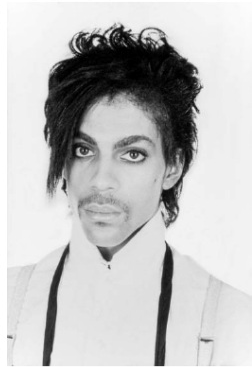
Goldsmith
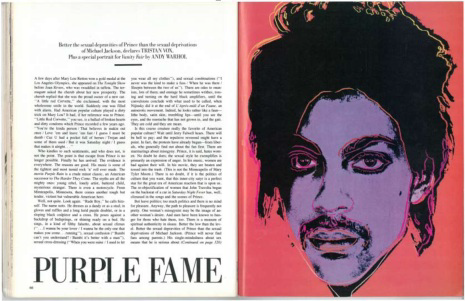
Warhol


So how did the argument go? The Court peppered the Foundation’s counsel with a wide range of questions, and at times expressed great concern that the test advocated by the Foundation for the first of the Section 107 fair use factors – the purpose and character of the use – cannot just focus on the “meaning or message” of the new work without severely limiting the rights of original creators. Justice Thomas asked the Foundation’s counsel if he took Warhol’s image, added the words “Go Orange,” and used it to promote the Syracuse University Athletic program (selling posters based on this new work at the same time), whether that use would be fair under the Foundation’s test, since the meaning and message of this new work were different from Warhol’s. When the Foundation’s counsel said probably not, Justice Thomas suggested that the Foundation’s position was both inconsistent and incapable of being practically applied. For her part, Goldsmith’s counsel attacked the Foundation’s position as putting the interests of copycats above the purposes of copyright.

At the same time, multiple Justices expressed concern that treating the “meaning or message” of new works as irrelevant, as the appellate court below had (arguably) done, was a step too far. Indeed, several Justices, notably Justice Kagan, appeared to argue for an approach in which a new work’s meaning or message could be considered as part of the inquiry into the purpose and character of the new use, but not as shorthand for that factor as a whole.

A recurring theme of the arguments was the nature of the “use” the Court was supposed to be considering for purposes of the fair use analysis. Was it Warhol’s original creation of the “Orange Prince” back in 1984, when he made a number of changes to Goldsmith’s photo, with her permission, for publication of the “Orange Prince” in a Vanity Fair article? Was it Warhol’s subsequent creation of fourteen additional works based on the Goldsmith Photo, dubbed the “Prince Series,” that now hang in museums and on the walls of collectors? Or was it the Foundation’s decision to license the “Orange Prince” to Vanity Fair again in 2016 for inclusion in another article about Prince following his death, this time without Goldsmith’s permission and without paying her? Goldsmith and the Solicitor General see this case as being about only (or at least primarily) the last of these uses, with the licensing of the “Orange Prince” essentially usurping a market Goldsmith actually exploits – the licensing of her images to media outlets – without compensation. But to the Foundation, the underlying meaning and message of Warhol’s “Orange Prince” – to comment on the reductive and dehumanizing nature of modern celebrity – was not diminished by the appearance of the “Orange Prince” in a Vanity Fair article published after Prince died. And, per the Foundation, the case is also about the original act of creation and the need to foster the ability of future artists to make use of preexisting works to communicate their own messages on subjects of their choosing.

Another source of dispute between the parties and, at times, the Justices themselves, was what the purpose of the use of the “Orange Prince” was. To the Solicitor General and Goldsmith, the purpose of the two images was the same – to show Prince as Prince, unlike Warhol’s prior use of Campbell’s Soup cans to comment on consumerism, not to sell food products – such that no further inquiry into that aspect of the first fair-use factor was necessary. But Justice Roberts appeared to reject that argument, noting how different the two Prince images were, and that both communicated different messages. The Foundation argued on this point that, per the Supreme Court’s prior holding in Campbell v. Acuff-Rose, 510 U.S. 569 (1994), it was not necessary for any court to determine what the meaning or message was of a new work, but that what mattered was whether a new meaning or message could reasonably be perceived from the new work.

Both counsel for Goldsmith and the Solicitor General were asked for their own tests as to how to evaluate the first fair use factor, and both advocated, at various points and somewhat inconsistently, for a requirement that the second artist show that it was “essential,” “necessary” or “highly useful” for them to use the first work. But several Justices expressed concerns that these proposed tests were overly limiting and/or too vague, and the Foundation vigorously argued that a test based on “necessity” would eviscerate the fair use defense and chill both creativity and freedom of expression.

Finally, and for parties, perhaps most importantly, there is the question of what the effect of a Supreme Court holding will have on the case at hand. Several Justices asked what would or should happen if the Court ruled in favor of one side or the other on the first fair use factor, since none of the other three fair-use factors had been briefed. The Court gave no clear sense about what would happen next if it ruled for either side, although the prospect of a remand to the Second Circuit or the District Court was brought up by a number of Justices, depending on how the case was decided.

In the end, what this case boils down to is balancing two equally important rights: the right of original creators to safeguard their copyrights and be compensated for their expression, and the right of secondary creators to innovate and build upon preexisting works, even if they are copyrighted. The Supreme Court argument did not clarify whether the balance is likely to tip in favor of one right or the other, or how to demarcate the boundaries between a use that is infringing and a use that is fair. Equally unclear is whether the Court will issue a limited ruling that does little more than address either the specific facts of this dispute or the interpretation of the first fair-use factor, or offer a broader balancing test capable of wider applicability in copyright cases that covers fair use as a whole. The decision, when it comes down, likely in 2023, will surely be an interesting and important read regardless of the outcome.

Related Categories:

Copyrights

Firm Highlights

Insights

Minnesota Consumer-Fraud Enforcement: Disclaimers Won’t Cure Deception, and Penalties Can Add Up

Misleading advertising claims can lead to costly consequences. In State of Minnesota ex rel. Ellison v. Wall & Associates, Inc., No. A25-2064, 2026 WL 3118291 (Minn. App. Oct. 19, 2026), the Minnesota Court of Appeals recently affirmed a bench trial verdict against a tax-relief company and two executives for violations of the Minnesota Consumer Fraud Act (“MCFA”) and the Minnesota Deceptive Trade Practices Act (“MDTPA”). The decision, which affirmed a substantial restitution and civil penalty judgment, underscores the broad power of the Minnesota Attorney General to act against deceptive sales practices. The decision also offers practical lessons for businesses seeking to reduce liability risks in consumer-facing communications. Background Wall & Associates (“W&A”), a Virginia-based tax-relief company, marketed assistance to taxpayers seeking relief from outstanding federal and state tax liabilities, often with offers in compromise—agreements to settle tax liabilities for less than the amount owed. In its extensive advertising campaigns, W&A represented that its average client received a 90% reduction in their tax debt, that it was a local company with Minnesota offices, that it provided legal services, and that it would “Solve ALL Tax Problems.” In reality, W&A’s promises bore little resemblance to what many clients received. Most of W&A’s clients saw just a 9.5% reduction in federal tax debt and 1.2% in state tax debt. W&A had no permanent Minnesota offices. And W&A provided neither legal representation nor assistance with filing tax returns—those services required referrals to separate firms for an additional fee. All the while, W&A clients paid upfront and recurring fees, including during periods when W&A did no work on their cases. Minnesota Attorney General Keith Ellison sued W&A, its founder and owner Ernest Kenneth Wall, and its president and CEO Patrick Mark Yates, alleging violations of, among other laws, the MCFA and the MDTPA. Following a 12-day bench trial, the district court determined that W&A violated the MCFA and MDTPA through its false and embellished advertising. The district court also held Wall and Yates individually liable for those violations because they directed, participated in, and acquiesced in the violations. The district court ordered injunctive relief, $2.7 million in restitution (with Wall and Yates jointly and severally liable for $1.3 million), and civil penalties of $786,517 against W&A, $415,500 against Wall, and $207,750 against Yates. The district court also awarded over $2.5 million in attorneys’ fees and costs to the state. W&A, Wall, and Yates appealed to the Minnesota Court of Appeals, which affirmed the district court’s decision on October 19, 2026. Although W&A, Wall, and Yates challenged the judgment on numerous grounds, several highlights of the decision provide important takeaways for consumer-facing businesses. Individual Reliance Is Not Required for Statutory Liability W&A argued that Attorney General Ellison had to prove a causal nexus between each violation of the MCFA and MDTPA and the injury to a particular consumer to establish liability. In W&A’s view, this required proof that each injured consumer had personally relied on W&A’s false representation. The Court of Appeals rejected this argument based on the MCFA’s and MDTPA’s plain language, which requires no proof of actual deception or confusion by consumers. The Court of Appeals finally pointed to the Minnesota Supreme Court’s decision in State v. Minnesota School of Business, Inc., which held that when a defendant’s misrepresentations are directed at and affected “a broad group of consumers, proof of direct individual reliance is not required to establish a causal nexus between MCFA violations and the harm suffered by consumers.” 935 N.W.2d 124, 135 (Minn. 2019). The Court of Appeals affirmed, however, that a causal nexus is necessary to support an award of damages under the MCFA and MDTPA. In making that determination, district courts look to various factors, including whether the misrepresentations were “longstanding, pervasive, and widespread in communications directed to consumers,” whether the seller intended and understood that consumers would rely on the misrepresentations, and whether the information was of a kind on which consumers would typically rely. The Court of Appeals’ decision continues Minnesota School of Business’s broad interpretation of liability under the MCFA and the MDTPA. Coordinated marketing campaigns to a “broad group of consumers” may expose businesses to MCFA and MDTPA liability without customer-by-customer proof of injury. That said, a causal nexus remains an element of an MCFA and MDTPA claim, and businesses involved in litigation should build a clear record at trial and on appeal showing how each of the relevant factors bears on the causal-nexus inquiry. Contractual Disclaimers Are Not an Automatic Defense to a Misleading Pitch W&A next argued that disclaimers in its client contracts prevented consumers from claiming they had been misled by its advertising. Reiterating that individual reliance is not required under the MCFA and MDTPA, the Court of Appeals held that a contractual disclaimer does not necessarily defeat a claim based on a conflicting oral representation. And on the facts of this case, the Court of Appeals agreed with the district court that W&A’s contractual disclaimers were insufficient given the extensive misrepresentations by W&A and the unequal bargaining power between it and its customers. This holding confirms that contractual disclaimers are not a cure-all for misleading advertising or sales practices. Businesses should review the entire customer journey, including pre-contract representations, as those representations may survive a contractual disclaimer to the contrary. And if faced with litigation, businesses should build a strong record, both at trial and on appeal, showing why any disclaimer is effective in context. The State Has Broad Authority to Seek Restitution W&A also challenged Attorney General Ellison’s authority to seek restitution under the state’s parens patriae authority to protect residents’ collective interests, arguing that injury to only 228 Minnesotans did not affect a sufficiently substantial segment of the population. The Court of Appeals rejected a simple headcount approach, instead explaining that the state had a legitimate interest in protecting residents’ economic well-being as a whole. In any event, the Court of Appeals held that if restitution was not appropriate under the state’s parens patriae authority, then it would still be appropriate under the Attorney General’s enforcement powers under Minn. Stat. § 8.31. The decision reinforces that the broader and more sustained the deceptive advertising, the stronger the case for restitution to protect Minnesotans’ economic interests. Civil Penalties Accrue Per Violation, Not Per Defendant The Court of Appeals finally rejected W&A’s claim that the Attorney General’s enforcement powers under Minn. Stat. § 8.31 permit only civil penalties of up to $25,000 for each defendant. Rather, the Court of Appeals explained that penalties are limited to $25,000 per violation. Multiple violations can therefore produce substantially greater penalties. The Court of Appeals also rejected the argument that restitution made penalties unnecessary: repaying consumers does not eliminate the need to address gains from deceptive conduct and deter future violations. Final Takeaways Align every consumer-facing communication. Broad and extensive marketing campaigns can expose businesses to stronger enforcement standards under the MCFA and MDTPA, making it critical that consumer communications remain accurate and consistent from the first advertisement through the final sale. Plan for layered enforcement exposure. Penalties under the MCFA and MDTPA can add up quickly: W&A, Wall, and Yates ultimately faced more than $6 million in civil penalties, restitution, and attorneys’ fees. The decision continues a line of Minnesota cases recognizing the Attorney General’s broad consumer-protection authority. Details matter. Although the Attorney General’s enforcement power is broad, it is not boundless. As the Court of Appeals explained, issues of causation, the effectiveness of contractual disclaimers, and the availability of restitution and civil penalties all turn on the specific facts of the case. Effective advocacy at trial and on appeal is critical to developing the facts relevant to liability and damages.